

AI Malaysia: 5 Powerful Ways Build a Future-Ready Digital Economy
By Ms. Tina Leon, Managing Director of Infra Mobile Digital Sdn Bhd 04/08/2026
Table of Contents
What is AI Malaysia, and why does it matter?
AI Malaysia Berhad is the national artificial intelligence entity established under Malaysia’s Ministry of Digital. Announced on 28 July 2026, it institutionalizes the former National AI Office and connects policy coordination with implementation. It matters because Malaysia now has a central body to guide the National AI Action Plan 2026-2030, responsible governance, safety, partnerships and high-impact delivery.
Artificial intelligence has already entered customer service, marketing, software development, manufacturing, finance, healthcare, education and public administration. Yet widespread use does not automatically produce national competitiveness. Without coordination, organisations may repeat the same experiments, talent gaps may persist, data may remain inaccessible and public trust may weaken.
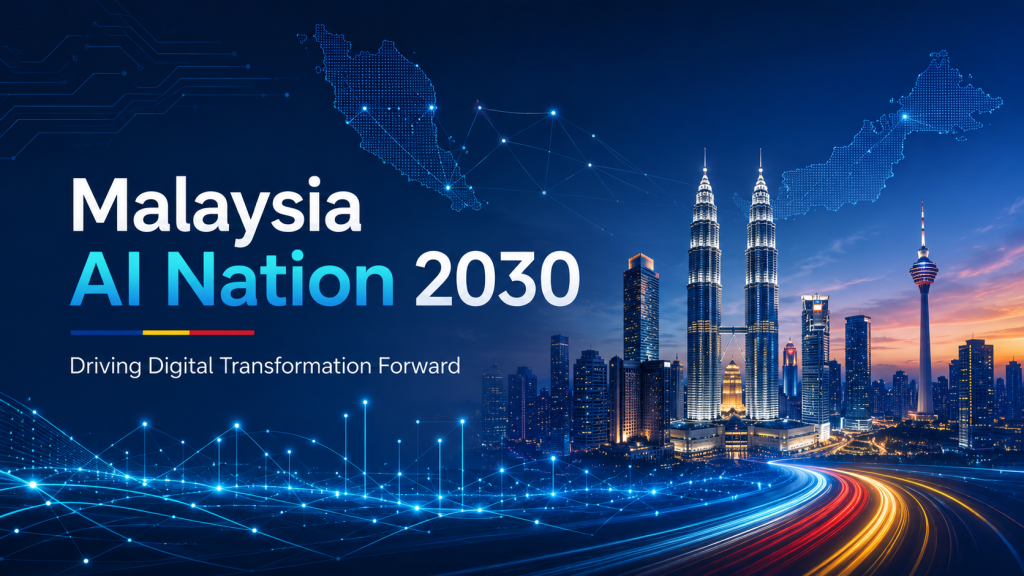
AI Malaysia is intended to address that execution challenge. Its launch supports the AI Nation 2030 aspiration and follows MD2030, which set national targets for digital growth, jobs, government savings and end-to-end public services.
1. AI Malaysia connects national policy with implementation
Malaysia has introduced multiple digital strategies, agencies and programmes over time. The challenge is ensuring that policy becomes coordinated action. According to the Ministry of Digital, AI Malaysia is positioned as an apex national body that unifies policy coordination and implementation through a whole-of-government approach.
Its responsibilities include coordinating policy, monitoring high-impact outcomes, developing trusted AI governance, managing strategic collaboration and fulfilling the role of the national AI Safety Institute. This combination is important because AI development crosses traditional boundaries. Data policy affects innovation. Talent affects adoption. Safety affects trust. Investment affects the ability to scale.
2. A structured action plan can focus resources on real outcomes
The National AI Action Plan 2026-2030 includes 14 sectoral initiatives and 14 enabling initiatives. The sectoral component is intended to generate direct socio-economic impact, while the enabling component strengthens the conditions required for implementation.
This structure is valuable because AI cannot be developed as a single, isolated programme. A healthcare use case and a manufacturing use case may require different data, standards and subject-matter expertise. At the same time, both depend on common enablers such as people, infrastructure and responsible governance.
For companies, the practical lesson is to organise AI investment in the same way. Begin with a defined business or customer outcome, then identify the enabling capabilities needed to support it. An organisation may want to reduce customer response time, for example, but the solution may require cleaner data, system integration, workflow redesign, employee training and review controls.

3. Responsible governance can increase confidence in adoption
Fast AI adoption without governance creates risk. Employees may place confidential information into unapproved tools. Automated outputs may be accepted without verification. Customers may not understand how their information is being used. Different departments may apply inconsistent standards.
Malaysia is responding through the establishment of the Malaysia AI Safety Institute and the development of a proposed AI Governance Bill. The Ministry of Digital has stated that the proposed legislation will use a risk-based approach. Public engagement has also covered lifecycle responsibilities, incident reporting, safeguards and regulatory sandboxes.
Governance should not be treated only as compliance. Clear rules can help employees use AI with greater confidence because they understand the boundaries. It can also help customers and partners evaluate whether an AI-enabled service is accountable and trustworthy.
Businesses do not need to wait for every regulatory detail before acting. They can establish an AI policy, assign ownership, classify use cases by risk, approve tools and data sources, require human review for sensitive decisions, document incidents and train employees. These steps create a stronger base for future requirements.
4. Talent, data and infrastructure can become shared national advantages
Talent must extend beyond data scientists. Malaysia needs business leaders who can identify worthwhile use cases, operational teams who can redesign processes, technical professionals who can build and integrate systems, and governance specialists who can manage risk. Universities and industry therefore have a shared role in developing practical, multidisciplinary skills.
Data and computing infrastructure are equally important. An organisation may have advanced AI tools but still struggle if its data is fragmented, poorly governed or unavailable in a usable format. Improving data quality and access is often the highest-value early investment.

5. AI Malaysia can expand opportunity for local innovation
MD2030 calls for Malaysia to progress from consuming technology to producing local innovation. AI Malaysia can support this shift by coordinating partnerships, monitoring high-impact programmes and encouraging market-driven development.
The opportunity is particularly relevant for Malaysian technology companies that understand local sectors. A locally developed solution may be better positioned to address Malaysian workflows, language needs, customer expectations, industry practices and implementation constraints. This does not exclude global technology; local companies can integrate global capabilities while contributing sector expertise and accountable support.
Organisations such as IMD can participate by converting industry knowledge into usable platforms, implementation methods and practical training. SERO-AI®, for example, applies smart data, AI assistants, workflow automation, WhatsApp engagement and business intelligence to operational challenges. The wider opportunity is for more Malaysian companies to develop solutions that can be proven locally and later commercialised regionally.
What should Malaysian businesses do now?
First, leaders should place AI on the management agenda as a business transformation issue, not only an IT issue. Second, they should identify a small portfolio of use cases and rank them by value, feasibility and risk. Third, they should assess data readiness, system integration, employee capability and governance gaps.
A controlled pilot can then be selected. Its purpose should be measurable, its users should be involved, and its risks should be understood. After the pilot, the organisation should compare the result with the baseline and decide whether to improve, scale or stop.

A future-ready economy requires coordinated action
AI Malaysia gives the national agenda a clearer institutional centre. The potential benefit is not only more AI adoption, but better-connected adoption: use cases linked to economic priorities, innovation linked to markets, and speed balanced with trust.
For Malaysian businesses, the immediate opportunity is to prepare. Organisations that understand their data, processes, people and governance will be better placed to participate in the AI Nation 2030 economy than those that wait for a perfect moment to begin.
Explore how IMD can help your organization in AI direction into a practical, governed and measurable transformation roadmap.