
2026 AI Digital Transformation Closes Revenue Gaps Better
By Ms. Tina Leon, Managing Director of Infra Mobile Digital Sdn Bhd 01/11/2026
Table of Contents
A buyer asks about your project on WhatsApp. Your team replies quickly, shares the brochure and answers a few questions. The conversation looks promising. Then the buyer asks for a weekend viewing. Someone forwards the message to another colleague, who assumes the appointment has already been arranged.
By Monday, everyone has been busy. The buyer has gone quiet.
For the customer, the silence feels simple: nobody followed through. Internally, the cause may be harder to spot because each person completed their own task. The missing connection only becomes visible when somebody reviews the whole journey.
That small gap deserves a place in your next technology discussion. Businesses invest heavily in attracting attention, yet the next action can still depend on a forwarded message or somebody remembering to check a spreadsheet.
The latest enterprise AI announcements make this problem particularly relevant. They point towards technology that can carry useful information into the work that follows. For Malaysian businesses, this creates a practical opportunity to improve how enquiries become appointments, bookings and revenue.
What is AI digital transformation
AI digital transformation means redesigning business processes around connected data, AI assistance and automation so teams can complete work with fewer manual steps and clearer oversight. It involves deciding where information comes from, what should happen next and who remains responsible.
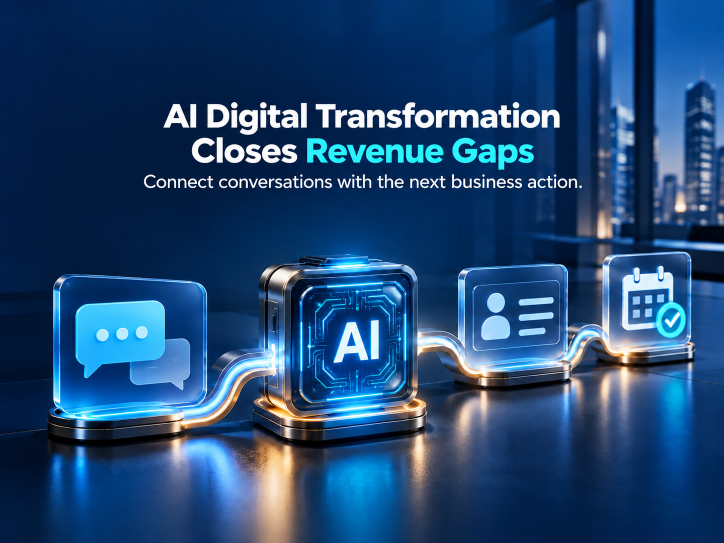
For a sales team, that could mean capturing a customer enquiry, assigning it to the right salesperson, recording the discussion and scheduling the next follow-up. Each step needs a reliable connection. An intelligent reply becomes more useful when the business can act on it.
An AI agent can use approved business information and connected tools to help carry out a task. A workflow determines when records move, reminders appear or approvals are needed. Both require design. Adding an AI assistant to a disconnected process can leave the same bottlenecks in place.
What the latest technology news tells business leaders
On 20 October 2026, Zoom introduced its Unified Context Layer, designed to connect conversation history with relevant documents and data. The announcement included workflows intended to turn meeting summaries into follow-up work, with availability varying by feature. The practical relevance is continuity: information discussed in one place can help inform action elsewhere.
Microsoft described a similar direction on 25 September. Its work IQ business applications preview began on 30 September, with rollout continuing through October. The aim is to give Copilot and agents business understanding drawn from Dynamics 365 and Power Platform, including relationships between records and the rules guiding subsequent actions. [2]
Meta’s research published on 14 October adds another perspective. In a Meta-commissioned YouGov study of 3,983 small-business owners across nine APAC markets, 76% reported positive productivity effects from AI, while 86% said businesses needed more guidance. Malaysia was outside the surveyed markets. These findings suggest that implementation support deserves attention alongside access to tools.
Our reading of these developments is that useful AI increasingly depends on understanding the work around a conversation. That understanding comes from organised business information and processes people can follow.
How can AI improve sales follow-up
AI can support sales follow-up by helping teams respond to routine enquiries, retain customer context and trigger the next agreed action through connected workflows. Results depend on accurate information, clear responsibilities and appropriate human involvement.
Consider the weekend viewing request. A better workflow would create or update the buyer’s record, identify the assigned salesperson and record the appointment request. The salesperson confirms the slot, while the system keeps the agreed details and next action visible.
If the buyer stops responding, the team can see the last meaningful conversation and decide how to follow up. If the buyer books, the record should carry forward the relevant information so administration can continue without asking sales to reconstruct the story.
This is where WhatsApp CRM integration becomes valuable. A conversation contains details that influence the next step, such as a preferred viewing time, a budget concern or a question about the booking process. Keeping that context accessible helps the next person respond appropriately.
The same principle applies across industries. A service company needs an enquiry to become a confirmed appointment. A distributor needs a quotation request to reach the person checking stock. In each case, AI workflow automation becomes useful when relevant information reaches someone with the authority and capacity to act.
Where ProSales AI fits into property operations

Property developers have several connected journeys to manage, from campaign enquiries and sales appointments to bookings, vacant possession and defect rectification. Different teams become responsible at different stages, which makes continuity especially important.
Within IMD’s ProSales AI ecosystem, ProCRM with AI supports lead management and follow-up, while Sales Booking supports the unit booking process. ProFix addresses VP and defect management. Together, these modules provide operational foundations for managing the property customer journey.
SERO-AI® adds a data hub and AI layer, with capabilities covering data consolidation, reporting, dashboards and assistants. IMD also offers practical AI and workflow training to help teams build confidence and improve system adoption.
For a developer considering AI CRM for property developers, the useful evaluation starts with a real enquiry. Ask the provider to demonstrate how it is captured, assigned, followed up and carried into booking. Then check which modules, integrations and configuration your particular process requires.
Start with the point where work gets stuck
A practical AI digital transformation project begins with one recurring problem. Choose a workflow that already creates delays, repeated checking or missed opportunities. A pilot around unassigned enquiries or overdue follow-ups gives the team something specific to improve.
First, map what happens today. Identify where the enquiry enters, who receives it, where the information is stored and how the next action is recorded. Include the awkward exceptions, because they often explain why work gets stuck.
Next, agree on the information the workflow needs. Standardise lead sources, pipeline stages and ownership. Confirm who maintains project information and how updates reach the people or assistants using it.
Set boundaries for automated actions. Routine answers can use approved material, while pricing exceptions, disputed records and unusual requests go to the responsible employee. Give staff time to practise these situations before expanding the workflow.
How can property developers measure AI ROI
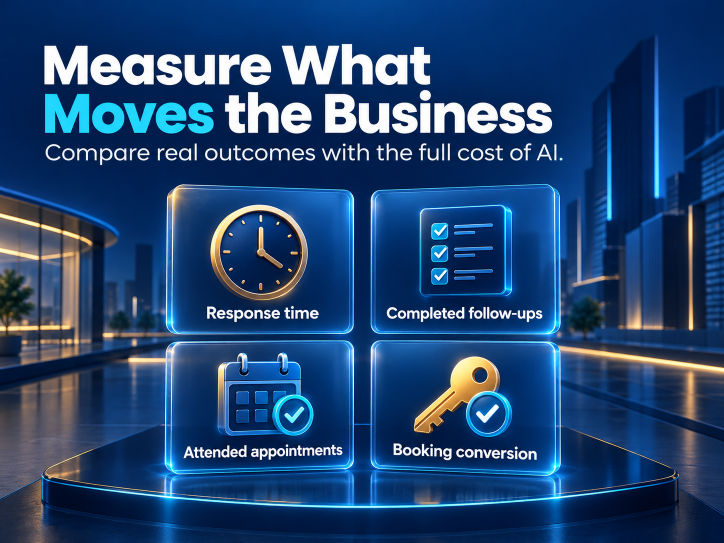
Measure AI return on investment by comparing the full cost of implementation and operation with verified time savings and business outcomes over a defined period. For sales workflows, track meaningful response time, completed follow-ups, attended appointments and booking conversion.
Compare similar campaigns and customer groups where possible. A stronger result may reflect pricing, incentives or better leads, so investigate the reasons behind a change before attributing it to AI.
Also count the work employees no longer need to repeat. Time spent finding records, preparing updates and checking ownership can be measured before and after the pilot. Include software, messaging, integration, training and maintenance costs in the assessment.
For example, a pilot might reduce the time needed to prepare a weekly sales update. Record the hours saved, check whether the report remains accurate and ask what the team achieved with that time. Those observations provide a more credible starting point for expansion than a busy dashboard alone.
A useful first question is whether your team can open any active enquiry and immediately identify its owner, status and next action.
The next technology investment should make a recognisable working day better. Bring IMD one workflow that keeps slowing your team down, and explore how ProSales AI and SERO-AI® could help connect the next step.
Book a consultation with IMD
