AI Digital Transformation in 2026: A Powerful Shift Towards Enterprise AI
By Ms. Tina Leon, Managing Director of Infra Mobile Digital Sdn Bhd 08/09/2026
Table of Contents
A customer asks for an update. Your team checks a spreadsheet, searches an email thread and messages another department. The answer eventually arrives, but several people have spent time finding information the business already holds.
For Malaysian businesses, this is where AI Digital Transformation becomes relevant. Recent developments involving Huawei, Nvidia, Google Cloud and Accenture raise a practical question: how can advances in AI help teams handle everyday work more effectively?
At Infra Mobile Digital (IMD), our view is that Enterprise AI should be assessed through the work it improves. A useful starting point is to identify where staff repeatedly search for information or wait for updates, then examine whether AI can help.
What the Latest AI Developments Mean for Your Business
The Edge Malaysia’s 17 September 2026 report highlighted Huawei’s ambition to challenge Nvidia with upcoming Ascend 960 chips. Reuters subsequently reported plans for two new chips in 2027. These announcements point to continued competition in AI infrastructure. Performance comparisons still need assessment against specific workloads.
As infrastructure options develop, businesses will need to assess software compatibility, support and running costs alongside performance. Everyday uses can often be served through a business platform or cloud service. The choice should follow the workload and data requirements.
Meanwhile, Google Cloud and Accenture are investing in implementation. Their 8 September announcement introduced the Accenture Gemini Enterprise Business Group, including plans for a 1,000-person engineering workforce to help clients deploy and scale AI. IT Brief’s coverage on 15 September examined the challenge of moving AI beyond pilot projects into wider business use.
Taken together, we see these developments as investment in two connected needs: the capacity to run AI and the expertise to make it useful inside organisations. For management, that makes implementation a central part of the AI investment decision.
What Does Enterprise AI Look Like at Work?
Enterprise AI means applying artificial intelligence within an organisation’s working environment, using relevant business information and appropriate controls. AI Digital Transformation is the broader process of changing how people, systems and workflows operate with that capability.
A practical example is an assistant that finds an approved procedure and explains the next step to an employee. An AI agent may go further by using connected applications to carry out a sequence of tasks within defined permissions. Google describes Gemini Enterprise as supporting connections to business data and agents that automate workflows across applications.
For your business, the important question is what happens after an answer is generated. Can the employee check its source? Does the relevant system receive an update? Is there a clear person to handle an exception? These details determine whether AI fits the work.
How Enterprise AI Could Support Property Developers
Consider a property developer preparing for vacant possession. Homeowners may ask about key collection, required documents and appointment arrangements. If approved notices sit in different folders and staff use different versions, introducing an AI assistant leaves a basic information problem unresolved.
An illustrative Enterprise AI workflow could connect an assistant to current, approved handover information. It could answer routine questions, request missing details and pass an unresolved enquiry to customer care with a summary. Access to individual appointment or unit information would depend on identity checks and the relevant system integration.
After handover, a homeowner reporting a water leak could receive guidance on submitting the necessary details. With suitable integrations and escalation rules, the assistant could flag the report for staff attention. The responsible team would assess urgency, coordinate the response and confirm any appointment. These are possible workflow designs, with capabilities depending on the implementation.
This example also explains why data preparation deserves attention early. A brochure, a customer record and a project update serve different purposes. Each needs a clear owner and an agreed way to stay current. Connecting more documents helps only when staff can identify which information is authoritative.
For Malaysian organisations serving customers in several languages, testing should include the language and terminology customers actually use. A system should handle English and Bahasa Malaysia consistently, alongside any other languages relevant to the business. Project names, abbreviations and incomplete enquiries deserve testing too.
Four Practical Steps to Begin AI Digital Transformation
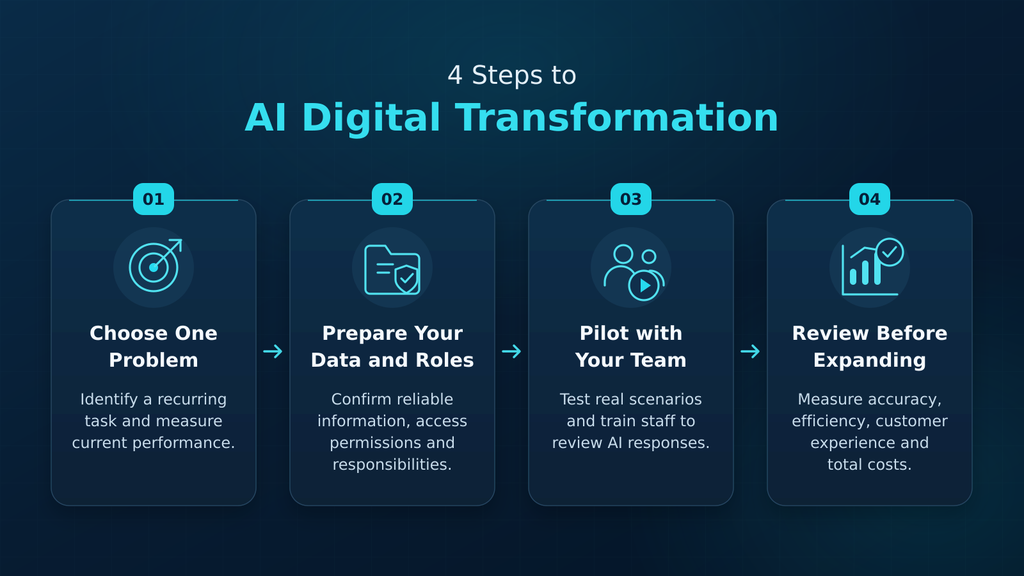
We recommend beginning AI Digital Transformation with one workflow that a team can measure and manage:
- Choose a recurring problem. For example, identify one category of customer enquiry that regularly requires staff to search several sources. Record current response times and the amount of staff effort involved.
- Prepare the information and responsibilities. Confirm the source documents, access permissions and person responsible for updates. Define which actions the assistant can take and when an employee must step in.
- Run a limited pilot with the people doing the work. Test routine questions, missing information and situations requiring judgement. Include training on checking answers, correcting errors and handing over cases.
- Review outcomes before expanding. Compare response time, answer accuracy, staff workload and customer experience with the starting position. Include integration, maintenance and support costs when assessing value.
A faster first reply is useful, but it does not tell management whether an enquiry was resolved correctly. Track the complete journey, including repeat contacts and corrections. Employee feedback can reveal where an apparently efficient process creates extra work elsewhere.
The investment in engineering and adoption highlighted by Google Cloud and Accenture supports a practical lesson: businesses should budget for implementation and ongoing improvement alongside the technology itself. An AI project needs someone to maintain its information and review how it performs.
Explore Enterprise AI with IMD and SERO-AI®
IMD’s SERO-AI® offering focuses on bringing business information together and supporting data integration. For organisations exploring Enterprise AI, that creates a useful starting discussion about which information should connect, who needs access and what operational outcome matters.
Your next step could be a focused review of one process that slows your team down. Bring the people involved, the information they use and the result you want to improve. Talk to IMD about building an AI Digital Transformation approach around that business need.
