
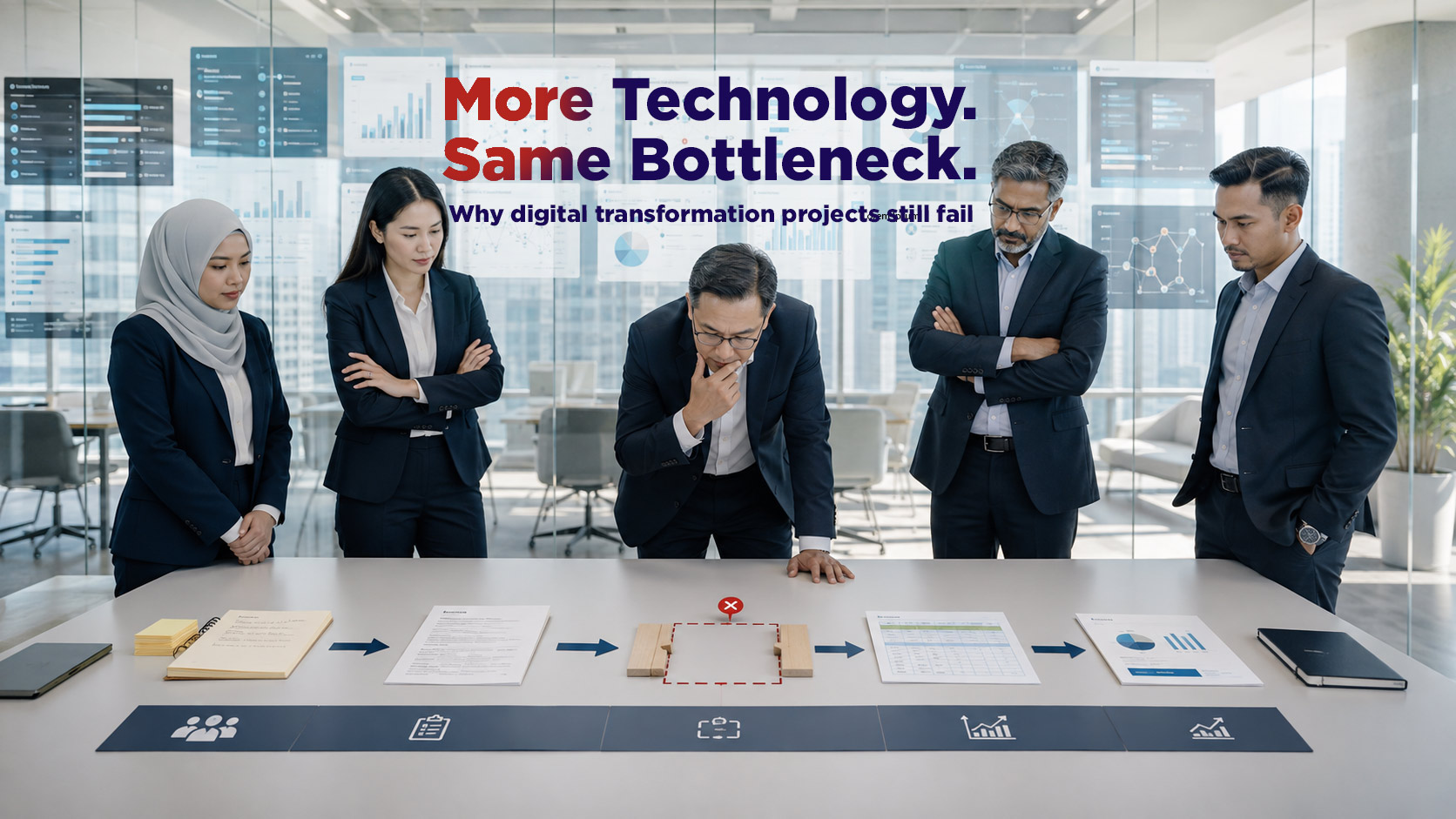
AI Digital Transformation: 7 Critical Reasons Projects Fail
By Ms. Tina Leon, Managing Director of Infra Mobile Digital Sdn Bhd 18/09/2026
Table of Contents
AI Digital Transformation is becoming a major priority for companies investing in CRM platforms, ERP systems, cloud applications, automation software and AI tools.
Yet even after significant investment, many organisations find themselves asking an uncomfortable question:
Why are we still working the same way?
Employees continue maintaining spreadsheets. Approvals still happen through email or WhatsApp. Management reports still require hours of manual consolidation. Customer information remains scattered across different systems and departments.
The technology may have changed, but the business has not.
This is one of the biggest misconceptions about AI Digital Transformation. Buying better technology does not automatically create a better organisation.
Successful transformation requires more than software. It requires the right conditions around the technology — including people, processes, data, leadership, change management and clear success metrics.
That is why even a technically successful implementation can still fail to deliver meaningful business improvement.
Here are seven common reasons AI Digital Transformation projects fail after companies invest in new technology.
1. People Weren’t Set Up to Succeed
A platform can have excellent functionality and still deliver little value if employees do not adopt it. Software is ultimately a tool. The outcome depends on how confidently and consistently people use it in their actual work.
Problems often begin when organisations treat employee preparation as something that happens near the end of implementation. A short training session is arranged, user accounts are distributed and everyone is expected to change overnight.
That rarely works. Employees need to understand not only how to use a new system, but also why the organisation is changing and how the new process will make their work better.
Without that understanding, familiar habits return. Teams create personal spreadsheets, keep information outside the new system or continue using manual processes because they feel quicker. For AI Digital Transformation, user adoption should therefore be treated as an implementation outcome in its own right.
What to do instead: Build practical training, communication, feedback and clear ownership into the project from the beginning.
2. The Process Wasn’t a Priority
Technology cannot rescue a process that was never properly designed.
Imagine an approval workflow involving unnecessary handovers, repeated checking and unclear responsibilities. Putting that workflow into a new digital platform may remove paper, but the same delays remain.
In some cases, automation can actually make the underlying problem more visible because a poor process is now moving faster without becoming better. This is why business process automation should begin with understanding the process itself.
• Where does work stop?
• Which steps are repeated?
• Where is information entered more than once?
• Who is responsible for moving work to the next stage?
• Which approvals actually add value?
These questions should be answered before automation begins.
What to do instead: Review, simplify and formalise the process first. Then automate the improved workflow.
3. The Data Was a Mess

AI depends on information. If that information is incomplete, duplicated, inconsistent or scattered across different systems, even a sophisticated AI platform will struggle to produce reliable results.
Consider a typical organisation. Customer information may sit inside a CRM. Finance has another set of records. Operations works from spreadsheets. Customer service manages conversations through email and WhatsApp. Management receives separately prepared reports.
The company has plenty of data. It simply does not have a connected view of that data. This makes data integration fundamental to successful AI Digital Transformation.
Before organisations expect AI to produce meaningful analysis, recommendations or automation, they need to understand where their information comes from, whether it is accurate and how it moves between departments.
This is also central to IMD’s approach to SERO-AI®, where fragmented organisational information is brought into a more connected environment to support analytics, automation and AI-enabled decision-making. Explore how SERO-AI® supports connected data
For many organisations, the first AI problem is actually a data problem.
What to do instead: Audit critical business data, remove duplication, improve structure and establish reliable sources before go-live.
4. The Wrong Tool or Vendor Was Chosen
A great software demonstration does not guarantee a great business fit. Vendors naturally showcase their strongest features. Competitors may also appear to be achieving impressive results with a particular platform.
But their requirements may be completely different from yours. Problems occur when organisations select technology based on features, hype or market popularity without first defining what the system needs to accomplish.
Before selecting a platform, companies should ask practical questions.
• Can it support our real workflow?
• Can it integrate with the systems we already use?
• What data does it require?
• Can our employees realistically operate it?
• Does it solve the business problem we originally identified?
• How easily can it scale?
A good digital transformation strategy does not begin by searching for the most advanced software available.
It begins by defining the requirement.
What to do instead: Choose technology against specific operational, integration and business requirements—not because the vendor demo looks impressive.
5. There Was No Clear Leadership Vision
“Implement AI” is not a business objective. Neither is “become more digital.” Transformation needs a clearer reason to exist.
For example:
• Reduce management reporting from three days to three hours.
• Improve customer response time.
• Reduce repetitive administrative work.
• Create one reliable view of customer information.
These outcomes give employees and management something concrete to work towards. Without a clear leadership vision, transformation projects are vulnerable to competing priorities, organisational politics and budget pressure. McKinsey’s research into stalled digital transformations found that common problems include a lack of strategic clarity and alignment, while stronger alignment before transformation begins can help maintain momentum.
Leadership must therefore do more than approve the technology budget. Leaders need to define why the transformation matters, connect it to business performance and continue reinforcing that direction after implementation begins.
IMD takes a similar approach when helping organisations develop a practical path across people, data, systems and workflows rather than viewing AI adoption as a standalone technology purchase. Read about IMD’s AI Digital Transformation approach
What to do instead: Anchor the programme to a clear, measurable business outcome from day one.
6. Change Management Was Skipped
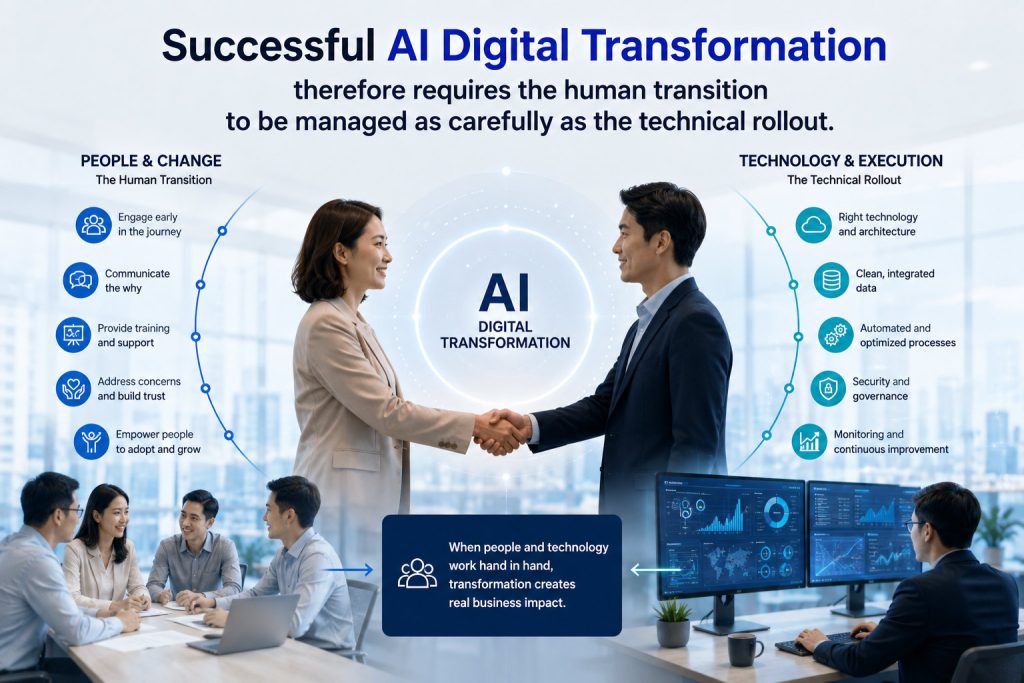
System training and change management are not the same thing. Training teaches someone how to perform a task inside the software.
Change management addresses a much bigger question: How will the organisation move from the old way of working to the new one? A new platform may change responsibilities, approval structures, communication channels, reporting methods and even how departments collaborate.
Employees need time and support to adapt. If that transition is not managed properly, teams often create workarounds or quietly return to familiar processes.
Leadership behaviour matters too. If management introduces a dashboard but continues requesting separate spreadsheet reports, employees quickly learn that the old process still exists. Successful AI Digital Transformation therefore requires the human transition to be managed as carefully as the technical rollout.
What to do instead: Combine communication, employee involvement, practical training, leadership reinforcement and ongoing support.
7. Success Was Never Defined
The software went live. Everyone received an account. Training was completed. Does that mean the project succeeded?
Not necessarily. Those are implementation milestones. They do not prove that the business has improved. Transformation should be measured against the problem it was designed to solve.
Depending on the project, useful measures could include:
• shorter reporting time;
• faster approvals;
• fewer manual updates;
• lower duplicate data entry;
• improved customer response time;
• increased follow-up completion;
• better management visibility; or
• fewer administrative hours spent on repetitive work.
Defining these measurements before launch creates a baseline. It also gives management a clearer way to decide whether an initiative should be improved, expanded or stopped. Without agreed metrics, even a successful project can struggle to demonstrate its value when budgets come under scrutiny.
What to do instead: Define business outcomes and success metrics before implementation—not after.
The Bottom Line: Software Was Only Part of the Problem
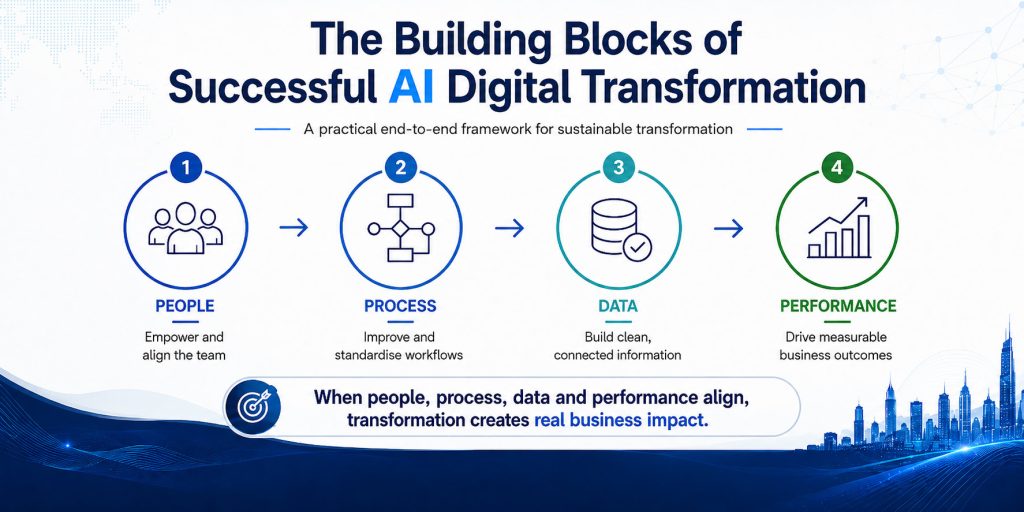
These seven failure points have something in common. The technology may not have been the real problem. The conditions surrounding it were.
People were not prepared. Processes had not been redesigned. Data was fragmented. The wrong platform was selected. Leadership lacked a clear outcome. Change was not properly managed. Success was not measured.
That is why AI Digital Transformation should not be treated as another IT implementation project.
It is a business transformation supported by technology.
A more practical way to think about it is:
People → Process → Data → Technology → Leadership → Change → Measurement
Each element supports the next.
This thinking is also reflected in IMD Practical Labs, where participants are encouraged to begin with real business problems, identify processes suitable for improvement and understand how data, AI and automation can work together before developing a practical transformation roadmap. See IMD’s practical AI transformation approach
Before Investing in Another Software Platform
Before purchasing another system, AI platform or automation tool, ask one question:
What business outcome are we trying to improve?
The answer may involve new technology. But it may also require cleaner data, a redesigned process, better data integration, employee training or stronger change management.
Often, several of these things need to happen together. That is the difference between installing software and transforming an organisation.
The goal of AI Digital Transformation is not to have the most AI tools. It is to build a business where people, processes, data and technology work together more effectively.
Start with the business problem. Build the right conditions. Then apply the right technology.
Start small. Scale smart. Transform with AI.
